
Responsible Gambling: Teen Patti Is a Game, Not a Strategy

If something feels wrong during reviewed sessions: call a helpline. BeGambleAware (UK): 0808 8020 133, 24/7, free. National Council on Problem Gambling (US): 1-800-522-4700, 24/7, free. Gamblers Anonymous: free peer support meetings worldwide. You don't have to be "addicted" to call. If the question is crossing your mind, the call is worth making.
The Honest Version of What This Site Is About
This site documents Pin Up's teen patti product in detail. That's useful for players who were going to play anyway. It is not an argument that you should play more, stake more, or treat teen patti as a money-making activity. Every strategy page I write comes with the same preamble: no strategy beats the house edge long-term. Strategy reduces your loss rate, it doesn't turn losses into wins. If you remember nothing else from this page, remember that.
Teen patti is fun. The dealer experience, the variant variety, the Mega Bonus trigger chasing — it's all genuinely entertaining. But the house edge is real. Over thousands of hands, the edge compounds into real money out of your pocket. That's the trade you make when you play. Accepting the trade with eyes open is fine; pretending the trade doesn't exist is the beginning of problem play.
Warning Signs to Watch For
Top three warning signs: playing longer than planned to "get back" what you lost; depositing more than your budget because you "feel like" you're close to a Mega Bonus trigger; and chasing the 2000:1 tier with escalating side bet sizes. Any of those three behaviours is a signal to stop, not a signal to push harder.
Other warning signs worth noticing: playing when you should be sleeping, hiding play from a partner, borrowing or deferring bills to deposit, feeling anxious about whether a session "worked," or feeling relief after a losing session because at least you didn't lose more. If you recognize yourself in any of these, please use the helpline numbers below before your next session.
Setting Limits That Work
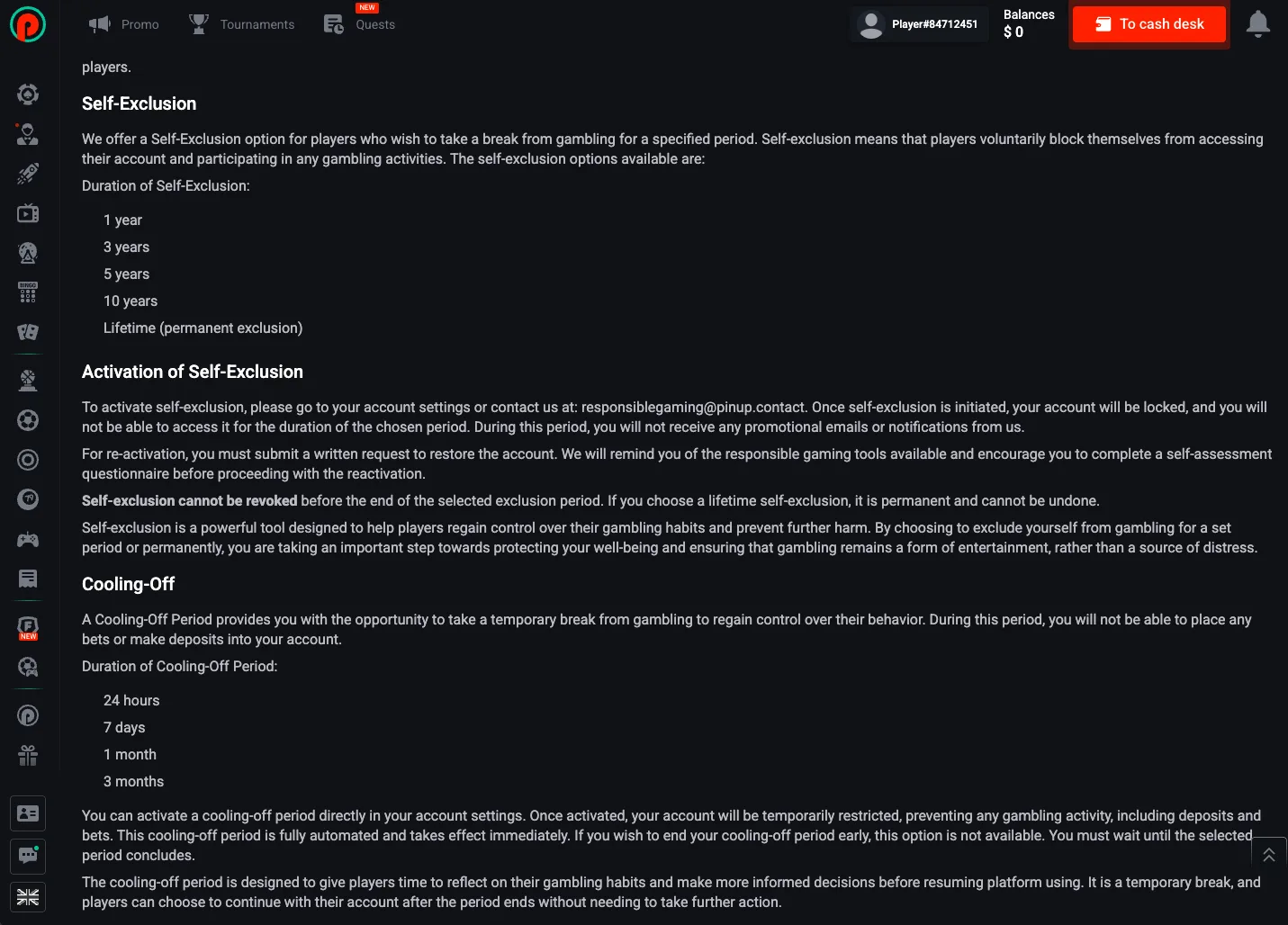
Pin Up offers deposit limits, session-time limits, loss limits, and self-exclusion tools from account settings. Deposit limits are the most useful because they're enforced at the transaction level — once you hit your cap, you physically cannot deposit more until the period resets. Set a deposit limit equal to what you can afford to lose in full, not what you hope or plan to lose. Assume every euro or rupee you deposit will be gone. If that assumption causes financial stress, the limit is too high.
Session-time limits break up long sessions where loss-chasing is most likely. A 60-minute session limit forces a break; many players who would have pushed through think better of it after thirty minutes away from the table. Loss limits work similarly but on cumulative money instead of time. Self-exclusion is the nuclear option and it's there for people who know they shouldn't keep playing but can't stop on willpower alone.
Why teen patti needs a different kind of caution
Teen patti is riskier for some players not because it has the highest edge in the casino, but because it feels social, readable, and winnable. A live dealer speaks to the table, variants have names and personalities, and the seen-versus-blind flow creates the illusion that you are always one good adjustment away from solving the game. That feeling is exactly why some players stay too long. The game offers just enough agency to feel strategic and just enough variance to keep hope alive.
That is why I prefer “decision hygiene” over generic warnings here. Before the session starts, decide your maximum deposit, maximum session length, and the exact event that ends play. During the session, do not reinterpret those rules because a variant feels soft, a dealer seems lucky, or a Mega Bonus is “due.” After the session, do not reopen the app just to relive hands or check whether the table is still running. Those tiny follow-up actions are where relapse and chasing often start.
Resources and Helplines
Helplines
- BeGambleAware (UK): 0808 8020 133, 24/7
- GamCare (UK): structured support programs
- Gamblers Anonymous: worldwide peer support
- National Council on Problem Gambling (US): 1-800-522-4700, 24/7
India-specific
- iCall (Mumbai): psychological first aid for mental health including gambling concerns, icallhelp.com
- NIMHANS (Bangalore): National Institute of Mental Health & Neurosciences helpline 080-46110007
Self-Help Tools
Why Chasing Mega Bonus Triggers Is Especially Dangerous
Mega Bonus triggers are rare by design. The 2000:1 tier hits roughly once in every 20,000 hands, which at a typical live table pace of 60 hands per hour is once every 333 hours of continuous play. No session gets you there. The correct mental model for Mega Bonus is "entertainment with a tiny lottery component," not "a goal I'm working toward." Any player who tells themselves "just a few more hands and the trigger will come" is falling into the gambler's fallacy — past hands don't change the probability of future hands.
The danger specific to teen patti side bets is that the 2000:1 headline is easy to fixate on. It's memorable, it's specific, it's the first number most players see when they read about the game. Treat it the way you'd treat a scratch-ticket jackpot: buy one occasionally for the thrill, never plan your finances around it. If you notice yourself placing side bets you can't afford "to chase the trigger," stop that session and read this page again.
If You Need to Stop
If reading this page made you realize you need to stop playing entirely, please close your Pin Up account, enable self-exclusion in the account settings, and call one of the helplines above. There's nothing weak or embarrassing about stepping away. The 2000:1 isn't coming. No rebate is worth harming yourself or someone who depends on you. The door is always open to walk back in months or years later if and when play becomes healthy again — but the decision to walk out today is the one that protects everything else.
What to do in the next 15 minutes if this page hit a nerve
Keep it simple. First, log out of Pin Up. Second, remove saved payment methods if you have access to that setting. Third, use a self-exclusion or at least a 24-hour cooling-off tool. Fourth, tell one real person that you need a pause, even if the message is short. Fifth, use one helpline from this page before you talk yourself into “one last session.” The right first step is not a perfect recovery plan. It is a break in momentum.
If you are not in crisis but you can feel your play drifting, use the site more selectively. Read the informational pages if you need clarity, but do not pair research with automatic play. A good rule is: never open the cashier and a strategy page in the same session. Keep learning and betting separate. That small boundary prevents a lot of bad decisions disguised as analysis.