
Pin Up Teen Patti Demo: Free Play Every Variant

Testing method
All demo statements are validated through direct title launch checks on desktop and mobile. Live-table behavior is documented separately.
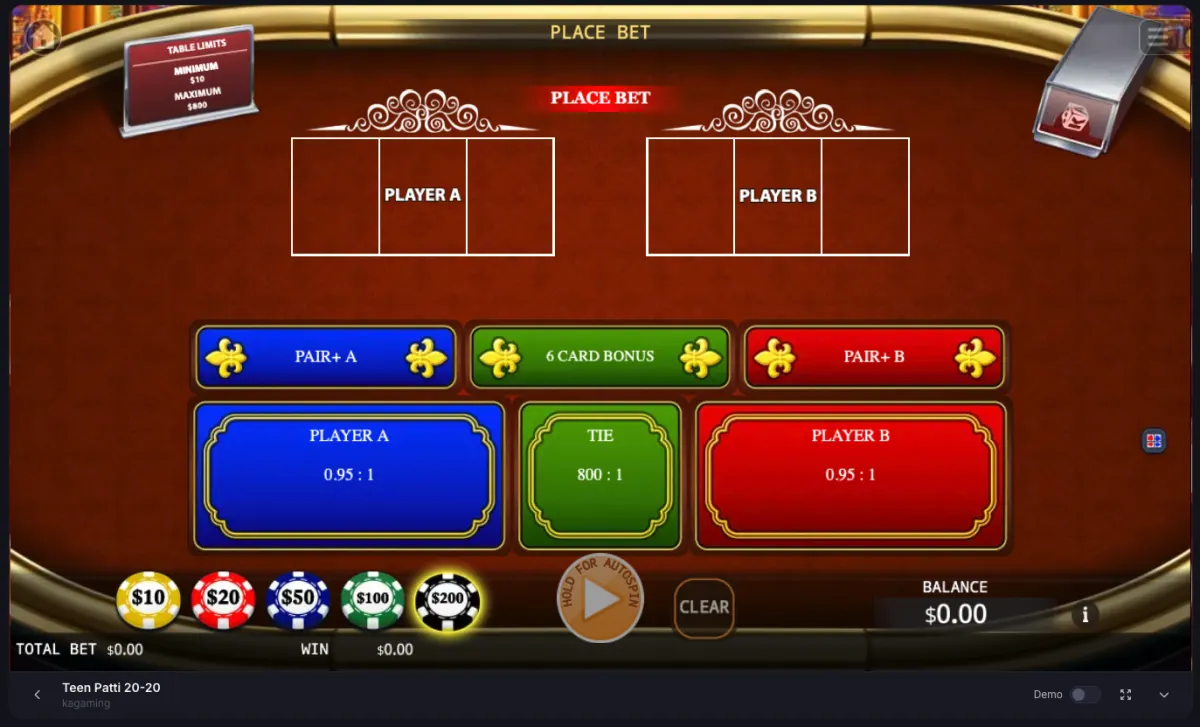
What Demo Mode Is
Demo mode lets you play teen patti at Pin Up without depositing real money. Pin Up's RNG teen patti titles run in demo credits — play money that doesn't reflect real wins or losses but behaves exactly like the real game otherwise. This is the single best way to learn the rules, test variants you haven't played before, and build comfort with the interface before committing real money. I recommend it for every new player, especially those trying Muflis, AK47, Joker, or Hukam for the first time.
Which Variants Are in Demo
All four RNG variants at Pin Up offer demo mode: Muflis, AK47, Joker, and Hukam. The RNG version of Classic also has demo mode. The live dealer Playtech Teen Patti Live table does not have a demo mode — live tables run with real dealers and real stakes only, which is standard across the industry. For live table practice, you'll need real money, but the minimum bet is low enough (₹100) that a small deposit lets you run a few exploratory hands without serious risk.
Ready to test the real live table?
Open Pin Up →How to Access Demo Mode
Open the Pin Up casino section and navigate to the teen patti category. Each RNG title has a "Play" button and a "Demo" or "Free Play" button — tap Demo to load the title with play credits. You don't need to be logged in for demo mode at most titles; some titles ask for a free account creation step, which takes about 60 seconds. No deposit is required at any point for demo mode. The UI is identical to the real-money mode, so anything you learn in demo transfers to real play.
What Demo Mode Teaches You
Rule Internalization
Demo is the fastest way to internalize teen patti's rules — hand rankings, the seen/blind decision, the ante/raise/fold flow, and showdown. Thirty minutes of demo sessions is worth more than two hours of reading rule pages, because muscle memory and decision reflex only build with actual gameplay. Play twenty hands in demo before your first real-money session and you'll feel meaningfully more comfortable.
Variant Familiarization
Demo is especially useful for variants. Muflis's inverted rankings feel alien at first; play fifty hands in demo and your brain will start categorizing hands correctly without conscious effort. AK47's wild cards need similar exposure — the first few hands feel overwhelming because wilds make so many combinations possible, but after twenty hands you're tracking wild positions naturally.
Strategy Testing
Demo lets you test the Q-6-4 strategy without financial consequence. Fold everything below Q-6-4 for fifty hands and track your demo bankroll change. You'll see first-hand that folding weak hands preserves credit better than playing them optimistically. That lesson transfers directly to real play.
What Demo Mode Can't Do
No Live Dealer Experience
Demo is RNG only. The live Playtech table with Priya or Rohit calling cards in Hindi is not available in free play — that experience requires real money. If you want to see what the live table feels like before deciding whether to commit, watch the Playtech stream from the lobby (you can observe without sitting at the table) for a few rounds.
No Emotional Weight
Play money is play money. The emotional weight of real stakes changes decision-making in ways demo can't replicate. A player who folds aggressively in demo sometimes discovers they can't fold as cleanly when real money is on the line. That's a human pattern, not a flaw in demo mode — just something to be aware of when transitioning from demo to real play.
No Real Winnings
Obviously: demo mode can't pay out real money. If you hit a Mega Bonus trigger in demo, it's fun but it doesn't convert to cash. For real winnings you need to deposit and play with real stakes.
Recommended Demo Workflow
Step 1: Play Classic in demo for 30-50 hands until you're comfortable with hand rankings and the seen/blind decision. Step 2: Try one variant (Muflis is the most interesting retraining exercise) for 20-30 hands. Step 3: Apply Q-6-4 strategy in demo for 50 hands and observe the bankroll change. Step 4: Make a small real-money deposit (₹500-₹1000) and join the live Playtech Classic table for your first real session. Step 5: If you want more variants, return to demo for AK47, Joker, or Hukam before committing real money to those variants.
When demo is enough, and when it is not
Demo is enough for learning interface flow, hand rankings, variant quirks, and whether you even enjoy the pace of teen patti. It is not enough for testing your emotional control, your comfort with blind-to-seen transitions under pressure, or how you react when a real-money session starts moving against you. That line matters. I like demo most as a filter: it helps you decide whether this game deserves any deposit at all.
If after 50-100 demo hands you still find the action confusing or the pace stressful, that is not a sign to deposit “so it feels more real.” It is a useful stop signal. On the other hand, if demo makes the decisions feel natural, the right next step is not a big bankroll jump. It is a small, controlled live session whose only goal is to compare your real-money discipline with your demo discipline.
The safest transition from demo to real money
The best bridge is a tiny first live session with one purpose. Deposit only what you are happy to lose as a test, pre-decide a stop amount, and play the classic table rather than a novelty variant. Do not combine your first live session with a welcome-bonus clearing attempt. Do not chase back to even if the first 10-15 hands go badly. Treat the session as a calibration exercise: are you still making the same folds and stake decisions you made in demo, or is real money changing your behavior immediately?
If the answer is “real money changed everything,” that is useful information, not failure. Go back to demo, reduce stakes, or pause the game entirely. Demo is most valuable when it teaches you not only how the game works, but whether the real-money version is a fit for your temperament.
Practical takeaway: the demo interface above is useful only if you treat it as training. If your real-money behavior changes after ten hands, pause and return to demo instead of increasing stake size.
Practice done? Time for the real thing.
Open Pin Up →